
The missing middle in Australia’s carbon forestry market
How a proposed new ‘ecoforestry’ approach could allow Australia to grow forests for carbon, biodiversity and timber – without having to choose between them.
By Dr Glenn Dale, Verterra Ecological Engineering
When we talk about planting forests in Australia, we have a tendency to put them into one of two boxes.
At one end are commercial plantations: forests established and managed primarily to produce timber, generally through a rotational system of harvest and re-establishment. At the other are environmental plantings: permanent forests established to sequester carbon and restore environmental values, with significant restrictions on harvesting. Both have an important role. But there is a substantial opportunity sitting between them.
What if we could establish bio-diverse forests that remain forested over the long term, maintain substantial carbon stocks and progressively develop greater ecological complexity – while also producing a sustainable supply of timber through selective harvesting, and recurring income for the people who manage them?
That is the idea behind a new approach we have been calling ‘ecoforestry’.
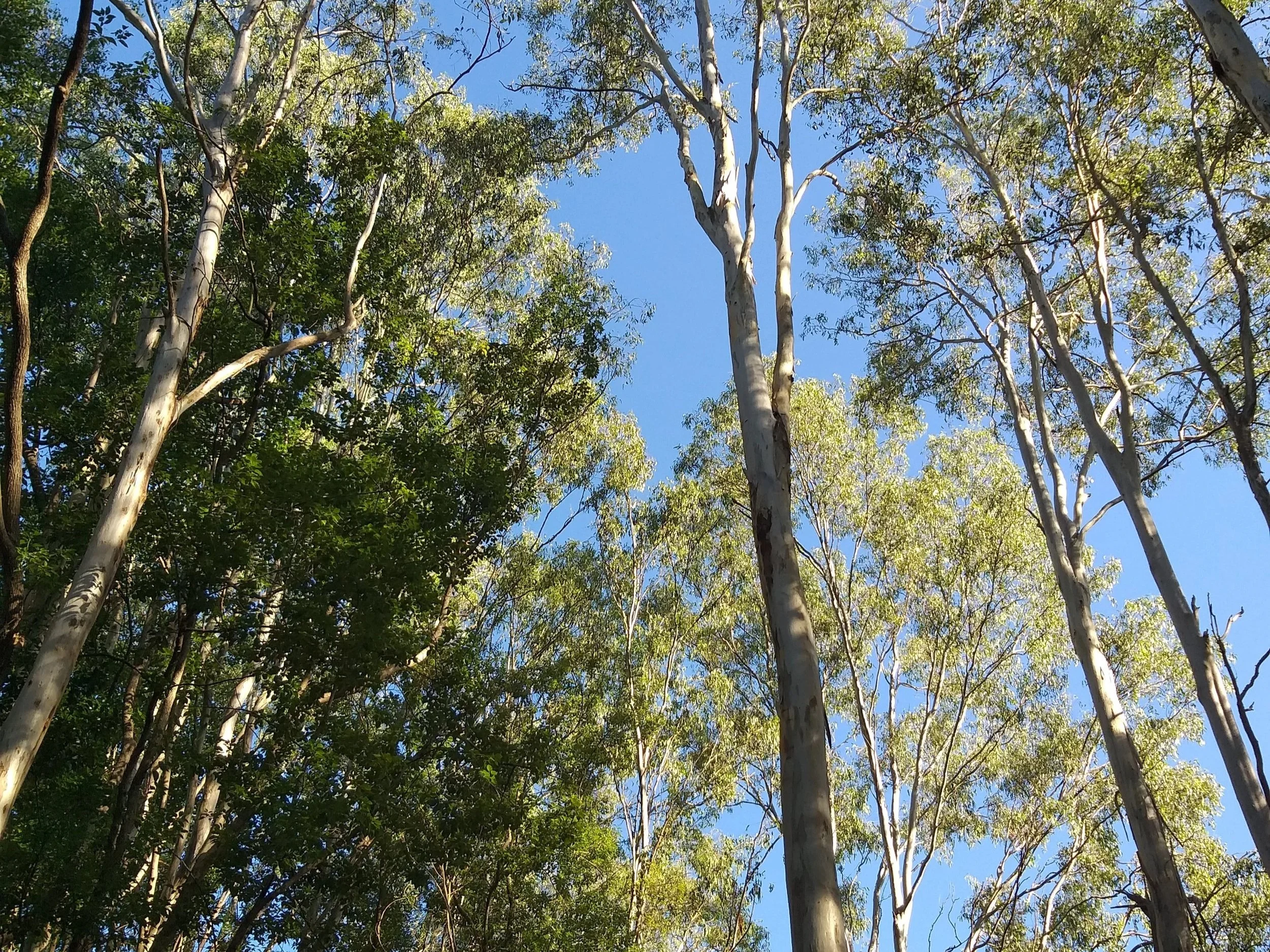
Ecoforestry aims to establish bio-diverse forests that remain forested long-term while also producing sustainable timber through selective harvesting.
A gap in the current ACCU Scheme
The current ACCU Scheme Plantation Forestry Method recognises several different forestry activities.
Schedule 1, for example, supports the establishment of new plantation forests for commercial harvesting. Schedule 4 provides for existing plantation forests to transition to permanent environmental plantings in certain circumstances. What it does not readily accommodate is a forest deliberately managed to sit between these models: one in which selective harvesting can occur periodically, without repeatedly returning the forest to the low-carbon starting point associated with clearfall and re-establishment.
Together with GreenCollar, Verterra has proposed a new ACCU Scheme method idea – Environmental planting allowing sustainable timber extraction – to address this gap. A closely aligned proposal, Reforestation for new multiple use biodiverse forests, has been independently developed by Mark Jackson of The Carbon Store.
The fact that three organisations with extensive experience of forestry and carbon markets between them, all arrived independently at very similar concepts tells us something important. There is an opportunity here that the current framework does not adequately capture.
What would ecoforestry look like?
Rather than growing an even-aged plantation through to clearfall, an ecoforestry project could establish environmental, mixed-species or native-species plantings and progressively manage them through selective thinning and harvesting. Only a relatively small proportion of timber would be removed at any one time. Natural recruitment, coppicing and supplementary planting could progressively create an uneven-aged forest containing trees of different sizes and ages.
The objective is not to avoid harvesting. It is to harvest in a way that maintains the forest.
Over time, such a system could combine characteristics we often treat separately: carbon sequestration, timber production, biodiversity, habitat connectivity and active forest management.
For landholders, it also introduces something particularly important – a reason to keep investing in the forest long after its period of peak carbon sequestration.
The carbon story is particularly interesting
At first glance, allowing timber harvesting within a carbon forest might sound contradictory. But if the forest is harvested in the right way, it works.
In a conventional plantation rotation, carbon accumulates as the trees grow and then falls substantially at harvest before beginning another growth cycle. Under an ecoforestry model, selective harvesting would remove smaller amounts of biomass while the majority of the forest remains standing and continues growing.
Modelling undertaken for the proposed approach illustrates the difference.
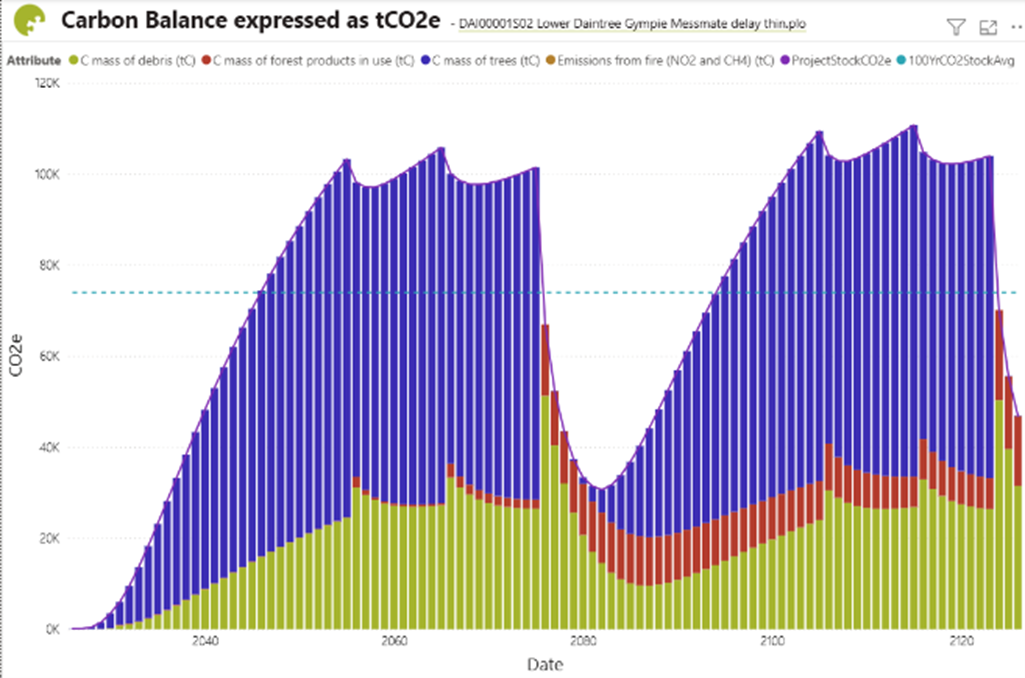
Modelled pattern of sequestration over 100 years for rotationally harvested plantings. Shorter rotations lead to lower average carbon storage over 100 years, which limits crediting under the existing Plantations method.
Graph: The Carbon Store/AnalytEx CarbalytEx package
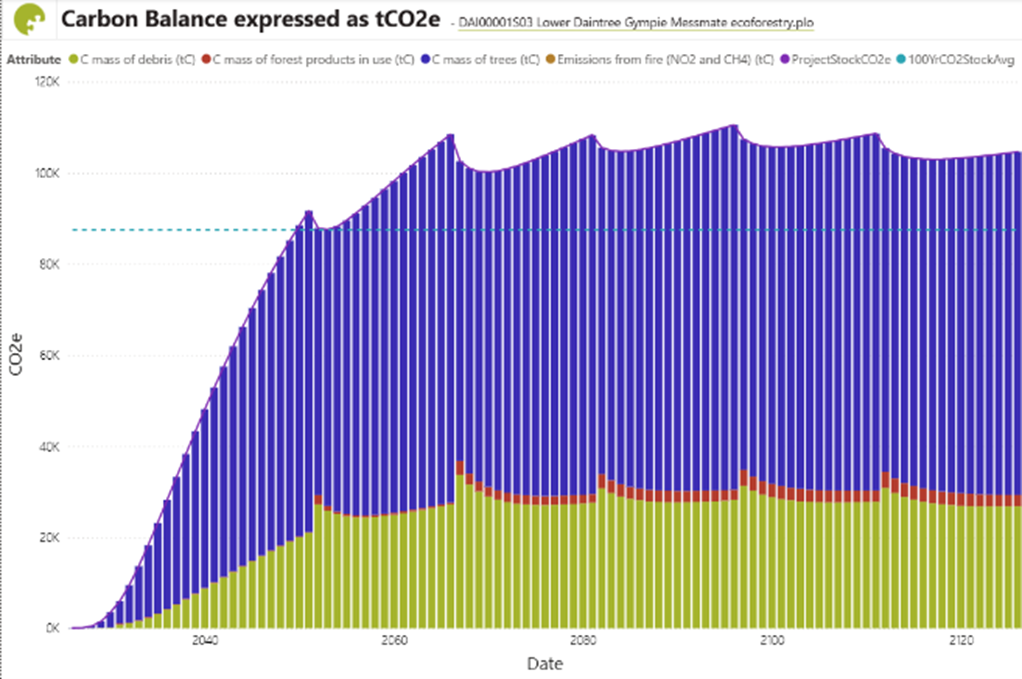
Modelled pattern of sequestration over 100 years for ecoforestry plantings. Note the higher average carbon (blue dotted line) in the ecoforestry planting. In this case it would lead to crediting finishing at 24 years for the ecoforestry planting versus at 21 years for the rotationally harvested forest.
Graph: The Carbon Store/AnalytEx CarbalytEx package
Across a 100-year period, the modelled ecoforestry stand maintains a higher average carbon stock than the comparable rotationally harvested plantation. In the scenario modelled, that higher long-term average carbon also extends the period over which sequestration can be credited.
That is an important distinction. We should not assume that productive forestry and high carbon storage are inherently opposing objectives. With the right silviculture, they can reinforce each other.
Opening carbon forestry to different landscapes
There is another reason this model deserves serious consideration.
Some of Australia’s highest rainfall and highest biomass regions should, intuitively, be attractive places to grow forests and sequester carbon. Yet the economics of conventional carbon projects do not always work well for smaller landholders in these productive landscapes. Land is valuable, project costs can be significant and carbon revenue eventually plateaus.
Adding a future stream of selectively harvested, potentially high-value timber changes that equation. It could make forest establishment more commercially attractive to smaller landholders while creating an incentive for active management over many decades.
The potential applications are diverse – from mixed-species rainforest plantings in North Queensland through to spotted gum and other productive native forests in South-East Queensland and New South Wales.
It could also create new corridors between remnant vegetation, restore cleared landscapes and contribute to domestic supplies of high-value timber.
Managing a forest for more than one outcome
Perhaps the bigger idea here extends beyond carbon methodology - we need to get better at designing landscapes for multiple outcomes.
A hectare of land does not necessarily need to be assigned exclusively to carbon, biodiversity, agriculture or forestry. Different values can coexist, provided they are understood, measured and actively managed.
This is particularly relevant as Australia develops increasingly sophisticated carbon and nature markets. We should be looking at landscapes and asking what the highest and best long-term use of the landscape can be – both environmentally and economically. Because, for either outcome to be sustainable, we need to deliver both.
Sometimes the answer will be permanent environmental restoration. In other places it will be conventional plantation forestry. But there is a large part of the landscape where a managed, diverse and productive forest may deliver more value over the long term than either alternative.
Creating forests people have a reason to manage
Australia does not need to choose between forests that store carbon and forests that produce timber. We need the policy architecture to recognise that forests can do both.
The proposed ecoforestry approach is still at an early stage. The two aligned concepts have been published among the Australian Government’s ACCU Scheme method ideas, and the next step will be to build the evidence, gather industry support and instigate the collaboration required to take a combined proposal into a future method-development round.
There will rightly be questions to resolve around carbon accounting, harvesting limits, additionality, forest management and safeguards. Those questions should be rigorously tested through the method-development process.
But the opportunity warrants that work.
If we can establish forests that retain high carbon stocks, become more diverse over time, provide habitat and landscape connectivity, produce valuable renewable timber and generate an economic incentive for their continued management, we should be looking seriously at how our carbon market can enable them.
That is not a compromise between conservation and production. It is simply good forestry.

Dr Glenn Dale is Managing Director of Verterra Ecological Engineering and an ecological engineer and forestry geneticist with more than 40 years’ experience in forest management, ecological restoration and natural resource management.