
Why Soil Sampling is the Foundation of Successful Land Rehabilitation
When land rehabilitation fails, the cause is rarely at the surface. Vegetation struggles to establish. Slopes erode. Water runs off instead of infiltrating. Mine closure criteria are missed. Carbon, forestry, or biodiversity projects underperform. And ultimately, landscape remediation costs escalate.
In most cases, the problem can be traced back to one thing: the soil beneath our feet. That’s why at Verterra, soil sampling is not a box- ticking exercise. It’s the foundation of every successful soil amelioration, landscape rehabilitation, and land-performance outcome we deliver.
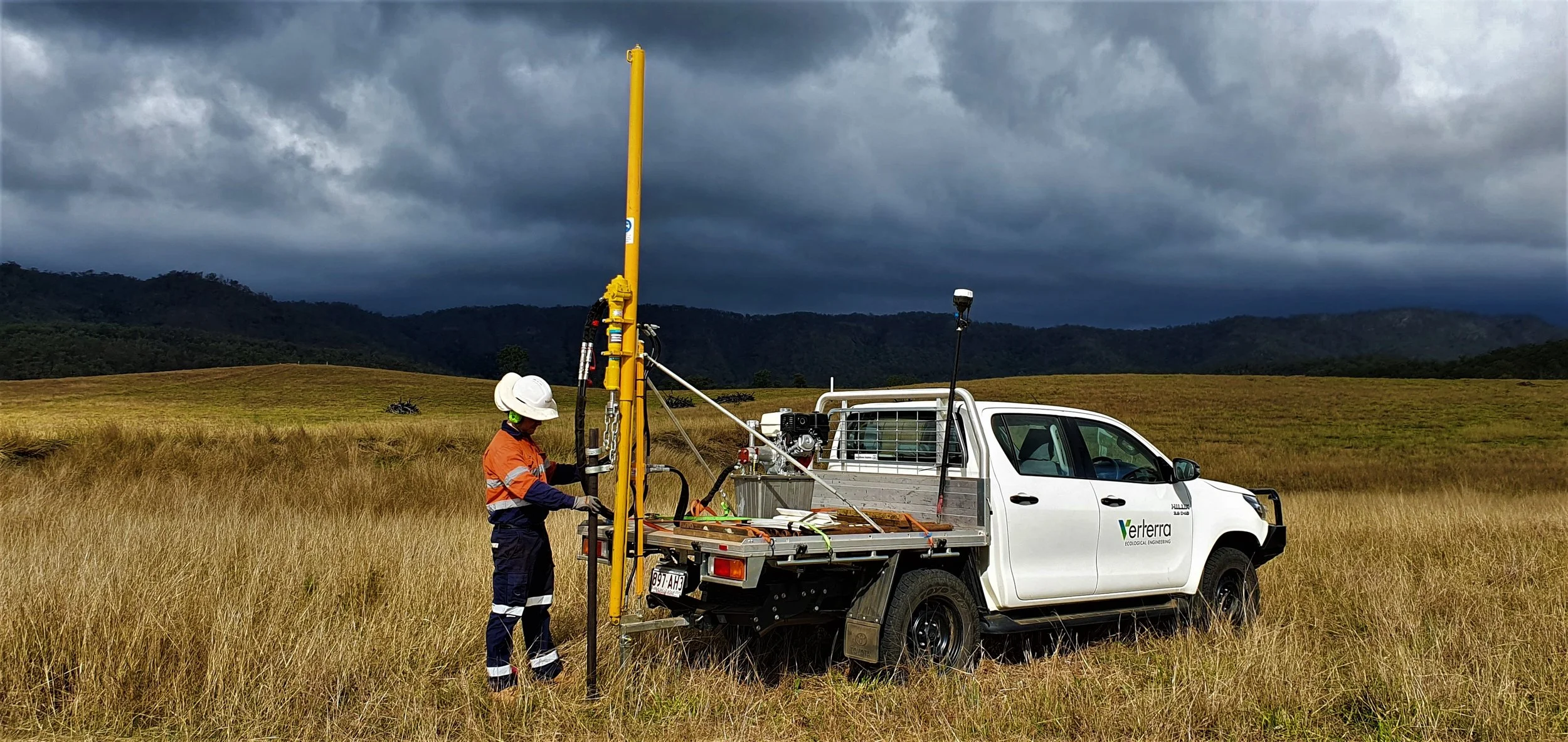
A good quality soil sampling program can unlock the keys to successful land rehabilitation.
Getting the Right Outcome Starts Below Ground
Whether the objective is to stabilise a post-mining landform, re-establish native vegetation, improve pasture productivity, or underpin a carbon project, the end goal is the same: grow the right vegetation, in the right place, for the long term.
That can only happen if the soil can physically support roots, chemically supply nutrients, and biologically sustain life.
Soil sampling tells us whether it can.
As Adam Costin, one of Verterra’s land rehabilitation specialists and a Registered Soil Practitioner in Soil Management, puts it:
“If we don’t understand the soil, we can’t reliably deliver vegetation outcomes or landform stability. Soil sampling reduces risk - it’s the foundation of everything else we do.”
What Is Soil Sampling — Really?
At its simplest, soil sampling involves collecting some soil and analysing it in a laboratory.
In practice, good soil sampling is a structured investigation into how a soil will behave, both now and into the future.
At Verterra, samples are typically taken at intervals from the surface to 1-1.5 metres below ground level, capturing the full soil profile that roots, water and nutrients will interact with over time. Across large or complex sites, this can mean hundreds of samples, depending on risk, regulatory requirements and landscape variability.
Each sample provides critical insight into three interconnected dimensions:
-
The physical structure of soil governs how water and roots move through the profile and how resistant the surface is to erosion.
Soil sampling allows us to understand:
Whether the soil is well-structured or degraded
If it is aggregated or prone to dispersion
How it will infiltrate rainfall or shed runoff
Whether it is likely to remain stable over time
These physical characteristics are central to landform stability. Poorly structured soils increase erosion risk, undermine slope stability and make revegetation far more difficult — regardless of what is planted.
-
Laboratory analysis reveals the soil’s chemical makeup, including:
Nutrient levels: both macronutrients (NPKS) and trace elements
pH: soil acidity or alkalinity, which determines nutrient availability
Salinity: affecting soil stability and ability to support plant growth
Exchangeable cations: proportions of calcium, magnesium, potassium and sodium
Exchangeable sodium percentage (ESP)
One of the most critical indicators for stability is ESP. When ESP exceeds around 6%, soils are considered sodic. High sodium relative to calcium and magnesium causes soil particles to repel each other, leading to dispersion, surface sealing, erosion and poor root penetration.
This is where sampling directly informs action.
For example, sodic soils can often be ameliorated using gypsum (calcium sulphate dihydrate) - a water-soluble source of calcium that replaces sodium on soil particles, allowing sodium to be leached from the profile, restoring soil structure.
Without sampling, these issues often remain hidden until failure occurs.
-
Soil biology - the microbes and other organisms that drive nutrient cycling - is essential for long-term soil function. While biology itself is complex to measure directly, soil chemistry and physical condition tell us whether biology is likely to flourish.
One of the strongest indicators is organic matter.
Low organic matter:
Limits nutrient availability
Reduces aggregation and structure
Constrains biological activity
When chemistry and physical structure are right, biology follows. Sampling allows us to identify whether soils can sustain biological processes or whether intervention is required to rebuild them.
Why Soil Sampling Reduces Risk
From a cost-benefit perspective, soil sampling consistently pays for itself.
It prevents unnecessary soil treatments
It reduces the risk of failed revegetation
It avoids costly rework during rehabilitation
It supports defensible decision-making for regulators, investors and auditors
In regulated environments such as mining, sampling density is often guided by formal requirements - for example, samples per hectare stipulated under State guidelines. But beyond compliance, the appropriate level of sampling is driven by risk, landform complexity and project objectives.
In simple terms: The higher the risk, the more important the data.
From Samples to Spatial Intelligence
Modern soil science doesn’t stop at lab results.
At Verterra, soil sampling data is:
Digitised
Spatially mapped
Integrated with topography and landform design
Used to guide targeted amelioration strategies and model landform stability
Previous sampling records and existing soil maps are reviewed first. Land attributes (geology, hydrology and topography) then inform where additional sampling is required. The result is a high-resolution understanding of soil variability across a site, not just isolated test results.
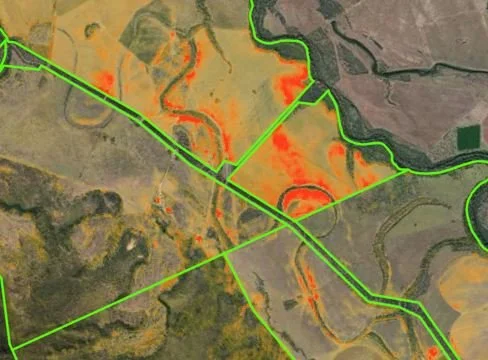
This is where Verterra’s proprietary tools come into play:
In a mining scenario, VerterraProve helps determine high risk areas, whereas in agriculture, DROVER Monitor identifies areas of underperformance. This helps determine where to sample and how much sampling is needed. (see high risk/underperforming areas highlighted on example image)
ReVive - Verterra’s unique soil assessment and amelioration system - delves further into physical, chemical and biological condition and translates that data into practical, science-based soil improvement strategies that are aligned with rehabilitation and land-use objectives.
Key Takeaway: Soil Sampling Is Not an Optional Extra — It Is the Starting Point
Too often, soil is treated as a uniform layer to be worked around rather than a complex system to be understood.
At Verterra, we take a different view.
Soil sampling is not a cost to be minimised - it is an investment in certainty.
By understanding what lies beneath the surface — physically, chemically and biologically — we can design landforms that stabilise, soils that sustain, and ecosystems that thrive.
Talk to our team to find out how our ReVive Soil Solutions can help you achieve your goals.